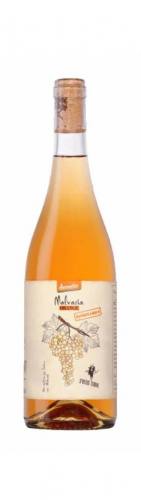
Cantina Orsogna Spiritus Terrae Malvasia Orange Terre d’Abruzzo IGT
Cantina Orsogna Spiritus Terrae Malvasia Orange Terre d’Abruzzo IGT ORG
Grape variety: 100% Malvasia
Origin of the Grape Variety
The origin and spread of Malvasia is a unique and wonderful adventure. The expression "Malvasia" derives from a contraction of the name of the Greek city of "Monemvasia" (capital of the Morea), a peninsula-fortress located in the Peloponnese, and means "one door," as the port leading to the fortress had only one entrance. The name Monemvasia was later transformed into "Malfasia" and Italianized to "Malvasia," and thanks to the Venetians, between 1500 and 1700, it became the most important wine in Europe. The Venetians, with their customary cosmopolitan openness, placed great importance on their wines, and a recurring phrase among them was: "We have neither fields nor vineyards, so we must obtain what we need from foreign and remote places." In the 16th and 17th centuries, wine in Venice was consumed in establishments differentiated by the quality and origin of the beverage offered. The "Malvasie" where "sea-borne wines" (i.e., imported by sea) were sold, almost always Malvasia, frequented by young Venetian patricians who chose these establishments for the rite of passage into active political and social life. The "Furatole": much more humble establishments selling fried fish and wine for "cicchetti" (aperitifs) enjoyed by the poor. The original Malvasia (Malvasia di Morea and Malvasia di Candia), in the Mediterranean, through cross-breeding with local grape varieties, gave rise to several varieties named Malvasia. Among others, we recall Istriana, Lazio, Bosa, and Lipari. Many of these vines produce wines with characteristics different from the original ones, and in this regard, Count Giuseppe Di Rovasenda, author of "Essay on Universal Ampelography," writes: "In my opinion, only those fragrant grapes with the special, slightly bitter flavor of Moscato should be called Malvasia. However, there are too many simple-tasting grapes called Malvasia [...] a name they carry unduly." The Malvasia grape has a rich and complex aromatic profile, all to be sensed in the wine: a broad spectrum of floral terpenes (acacia rose, freesia, lavender, and citrus), fruity notes (peach, ripe or unripe apricot, tropical fruit), herbaceous notes, and hydrocarbons—the latter during aging.
Breeding system
Tendone or "la capanne" in the local dialect. A traditional, expanded training system in the area, characterized by a low density of plants per hectare (1,100-1,600), allowing for the vine's natural harmonious growth. In the "capanne" system, harvesting and pruning are exclusively manual, closely linked to the winemaker and the smallholding.
Terrain and Altitude
Deep clay soils with limestone veins. Vineyards cultivated at 400-500 meters above sea level.
Type of Agricultural Management
Biodynamic with DEMETER certification. Biodynamic cultivation is important for the microbiological life of the soil, which is essential for the spontaneous fermentation of biodynamic wine. In conventional agriculture, the use of fungicides weakens yeast populations and makes spontaneous fermentation very difficult. Biodynamics restores the wine to its place of origin, defined by the French as "Terroir" (territoriality).
Winemaking: SPONTANEOUS FERMENTATION
For millennia, fermentation has occurred spontaneously, triggered by naturally occurring yeasts—so-called indigenous, native, or wild yeasts—which differ from area to area and are capable of transmitting the unique characteristics of the location and vintage to the wine.
WHAT KILLED SPONTANEOUS FERMENTATION?
Spontaneous fermentations, linked to wild yeasts, were challenged by the widespread use of pesticides, chemical fertilizers, and herbicides in the early 1960s, which destroyed the microbiological life of our vineyards, forcing the use of selected yeasts to initiate fermentation. Only with careful and clean farming, the fruit of a synergistic relationship with nature, can healthy, microbiologically "alive" grapes be brought to the cellar, capable of undergoing spontaneous fermentation and a winemaking process free from forcing and constraints, for a true expression of the terroir. Also crucial to the success of spontaneous fermentation is a winemaking technique that respects microbial life: adding sulfites to the grapes or musts kills the grape's microflora (yeasts) and compromises fermentation. This is the reason why spontaneous fermentation can only be carried out without the addition of sulphites, while in conventional fermentation the use of sulphite-tolerant industrial yeasts allows fermentation even with the addition of sulphites.
TERROIR AND MICROBIAL BIOGEGRAPHY
Biodynamic wines derive their complexity from spontaneous fermentation, where in the first phase of fermentation, apiculate yeasts impart the microbial terroir's fingerprint to the wine through unique organoleptic profiles. In conventional fermentation, apiculate yeasts are prevented from expressing themselves as they are eliminated by sulfites and the heavy colonization of added industrial yeasts.
NATURAL TARTARIC STABILIZATION
Finding small crystals (tartrates) in the bottle means that "the wine has felt the cold" and has released harmless natural precipitations. In biodynamic wine, no physical (refrigeration) or chemical (addition of carboxymethylcellulose, metatartaric acid, gum arabic and other) treatments are permitted and only winter cold is used as an element of tartaric stabilization. The conventional tartaric stabilization technique requires that the wine be brought from room temperature to approximately -6/-7 °C before bottling and kept at this temperature for a few days (6-7). The conventional tartaric stabilization technique, especially in the summer, leads to significant energy consumption. It's a real shame that this enormous energy consumption is required to avoid the presence of a few milligrams of harmless tartrate crystals.
LIMITS OF SULPHITES: Demeter biodynamic wine limit = white wine max 90 mg/lt
FILTRATION: Sterile filtration is not permitted.
REFINEMENT: Concrete and bottle tubs.
MALVASIA ORANGE WINE
It derives from the ancestral winemaking technique of our countryside, characterized by prolonged contact of the skins with the must, which gave the wine unusual flavors and colors. This technique disappeared with the advent of new winery machinery that removes the skins before fermentation. In Malvasia Orange Lunaria Ancestrale, the skins are left to macerate for two to three days with the must, without temperature control, without the addition of sulfites, and fermented with the grape's natural yeasts. During maceration, tannins are extracted, giving the wine the structure of a red. "Orange" wines, which are neither white, rosé, nor red (the fourth color of wine), deserve a category of their own. "Orange" wine, like red wine, contains significantly more antioxidants than white wine. This is because fermenting the must of white grapes in contact with the skins and seeds results in the extraction of polyphenols (resveratrol), which function as antioxidants in the human body. One study found that white wine produced through this maceration process has six times greater antioxidant activity than standard white wine. Its antioxidant activity is similar to that of red wine.
FOOD PAIRING
Precisely because it's a more structured wine than white wines, it's a good choice for pairing with more colorful and flavorful cuisine. It pairs very well with spices like curry or turmeric. It pairs well with peppery or semi-mature cheeses.
SERVE AT 10-12°C
SPIRITUS TERRAE BRAND
DEMONIMATION
MALVASIA ORANGE Terre d'Abruzzo
COLOR Orange
FORMAT 750 ml
CHARACTERISTICS
Native vine
Spontaneously fermented wine
CERTIFICATIONS
Guaranteed triple certification: Biodynamic (Demeter), Biodiversity Friend, and Organic.
BLOCKCHAIN CERTIFIED for non-irrigated vineyards and hand-harvested grapes.
UK law insists that you must be 18 years or over to place an order with us. By placing an order you confirm that you are at least 18 years old.
All deliveries must be signed for by an adult. We reserve the right not to accept any orders.. For the facts about alcohol visit drinkaware.co.uk