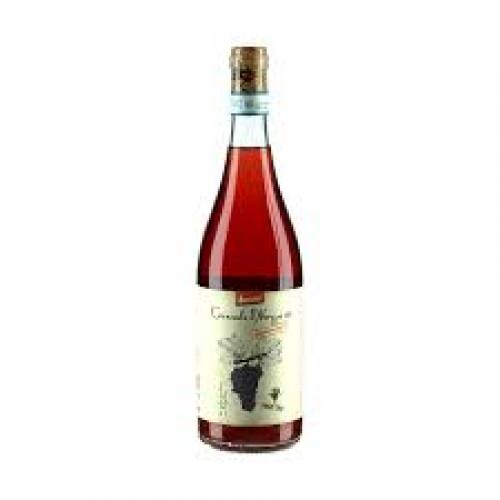
Orsogna Spiritus Terrae Cerasuolo
Orsogna Spiritus Terrae Cerasuolo
Bottle notes
Grape variety: 100% Montepulciano
Origin of the Grape Variety
The most widely cultivated grape variety in Abruzzo, its origins vary. The most reliable version is linked to the Medici family, who brought vine cultivation techniques and propagation materials from Tuscany to their Barony of Carapelle (17th century). Trade between Carapelle and Tuscany was not limited to vines alone, but also to the excellent wool that was transported from the peaks of the Apennines to Florence, where it was processed and sold throughout Europe. The area where this grape variety developed is the Peligna Valley, where written records of its cultivation date back to the 18th century. Montepulciano is a grape variety that can grow both in the mountainous interior and on the hills, all the way to the coastal areas. Since the post-war period, thanks to its versatility in adapting to different climates, its cultivation has spread to the entire coastal hillside.
Flagship of the area, its grapes produce a wine with a strong qualitative imprint, a deep and vivid color, a dense aroma with typical cherry notes and a varied and complex bouquet.
Tendone or "la capanne" in the local dialect. A traditional, expanded training system in the area, characterized by a low density of plants per hectare (1,100-1,600), allowing for the vine's natural harmonious growth. In the "capanne" system, harvesting and pruning are exclusively manual, closely linked to the winemaker and the smallholding.
Terrain and Altitude
Deep clay soils with limestone veins. Vineyards cultivated at 400-500 meters above sea level.
Type of Agricultural Management
Biodynamic with DEMETER certification. Biodynamic cultivation is important for the microbiological life of the soil, which is essential for the spontaneous fermentation of biodynamic wine. In conventional agriculture, the use of fungicides weakens yeast populations and makes spontaneous fermentation very difficult. Biodynamics restores the wine to its place of origin, defined by the French as "Terroir" (territoriality).
Winemaking
Spontaneous Fermentation: For millennia, fermentation has occurred spontaneously, triggered by naturally occurring yeasts—so-called indigenous, native, or wild yeasts—which differ from area to area and can transmit the unique characteristics of the location and vintage to the wine.
What Killed Spontaneous Fermentation?
Spontaneous fermentations, linked to wild yeasts, were challenged by the widespread use of pesticides, chemical fertilizers, and herbicides in the early 1960s, which destroyed the microbiological life of our vineyards, forcing the use of selected yeasts to initiate fermentation. Only with careful and clean farming, the fruit of a synergistic relationship with nature, can healthy, microbiologically "alive" grapes be brought to the cellar, capable of undergoing spontaneous fermentation and a winemaking process free from forcing and constraints, for a true expression of the terroir. Also crucial to the success of spontaneous fermentation is a winemaking technique that respects microbial life: adding sulphites to the grapes or musts kills the grape's microflora (yeasts) and compromises fermentation. This is the reason why spontaneous fermentation can only be carried out without the addition of sulphites, while in conventional fermentation the use of sulphite-tolerant industrial yeasts allows fermentation even with the addition of sulphites.
Terroir And Microbial Biogegraphy
Biodynamic wines derive their complexity from spontaneous fermentation, where in the first phase of fermentation, apiculate yeasts impart the microbial terroir's fingerprint to the wine through unique organoleptic profiles. In conventional fermentation, apiculate yeasts are prevented from expressing themselves as they are eliminated by sulfites and the heavy colonization of added industrial yeasts.
Natural Tartaric Stabilization
Finding small crystals (tartrates) in the bottle means that "the wine has felt the cold" and has released harmless natural precipitations. In biodynamic wine, no physical (refrigeration) or chemical (addition of carboxymethylcellulose, metatartaric acid, gum arabic and other) treatments are permitted and only winter cold is used as an element of tartaric stabilization. The conventional tartaric stabilization technique requires that the wine be brought from room temperature to approximately -6/-7 °C before bottling and kept at this temperature for a few days (6-7). The conventional tartaric stabilization technique, especially in the summer, leads to significant energy consumption. It's a real shame that this enormous energy consumption is required to avoid the presence of a few milligrams of harmless tartrate crystals.
Limits Of Sulphites
Demeter biodynamic wine limit = rosé wine max 60 mg/lt
Filtration
Sterile filtration is not permitted.
Refinement
Concrete and bottle tubs.
Sensory characteristics
Colour: Bright cherry pink.
Aroma: pleasant, fine, with a hint of vinous accent, and a fruity bouquet.
Flavour: soft, harmonious, and delicate, with a subtle almond aftertaste. Slightly acidic, well-balanced.
Food Pairing
Perfect for pairing with aperitifs, fish soups, pasta dishes, delicate cheeses, and light roasts, his wine is also perfect with simple dishes like pizza.
Serve at
12-14°C
UK law insists that you must be 18 years or over to place an order with us. By placing an order you confirm that you are at least 18 years old.
All deliveries must be signed for by an adult. We reserve the right not to accept any orders.. For the facts about alcohol visit drinkaware.co.uk